

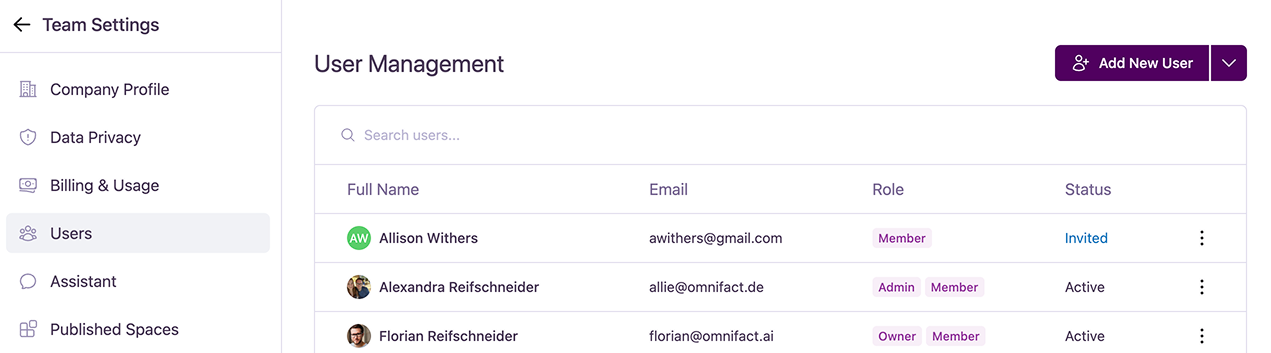
Understanding the User List
The main part of this page is the user list, which provides an at-a-glance view of your team.- Full Name: The user’s full name.
- Email: The email address associated with the user’s account.
- Role: The user’s permission level within the organization (Owner, Admin, or Member).
- Status: The current status of the user’s account (e.g., Active, Deactivated, Invited).
Adding New Users
You have two ways to add new members to your team.Add a Single User
Add a Single User
Click the “Add New User” button to open the “Invite User To Team” dialog.
Import Users from a CSV File
Import Users from a CSV File
For adding multiple users at once, you can use the CSV import feature.
- Click the dropdown arrow next to the “Add New User” button.
- Select “Download CSV Template” to get a correctly formatted file.
- Fill out the template with the user details (e.g., Full Name, Email, Role).
- Select “Import CSV File” and upload your completed file to send out bulk invitations.
Managing Existing Users
For each user in the list, you can click the ”…” (more options) menu on the right to perform various actions.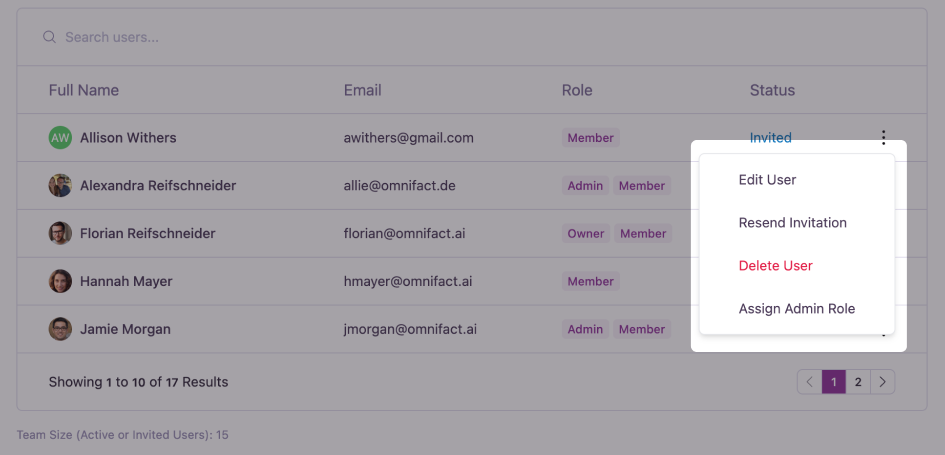
- Edit User: Opens the “Edit User” dialog where you can update the user’s details.
You can modify the First name, Last name, Email, and assign or revoke the Admin role. Click “Update User” to save the changes.

- Deactivate User: Suspends the user’s access to the platform. Their status will change to “Deactivated.” This will prevent them from logging in to the platform.
- Assign Admin Role: Promotes a Member to an Admin, granting them additional permissions. For existing admins, this option becomes “Revoke Admin Role.”
- Resend Invitation: For users with an “Invited” status, this resends the invitation email.
- Delete User: Permanently removes a user from the team. You can only delete users who have not yet accepted the invitation.
User Roles
Omnifact uses a role-based system to manage permissions.Owner
The highest permission level. There is typically only one Owner per team. Owners have all Admin rights in the team.
Admin
Admins can manage users, roles, and Team Settings. They can invite and remove users and change the roles of other members (except the Owner).
Member
The Member role is the standard permission level for most users. It grants full access to Omnifact’s core features—including Chat and the ability to create and use Spaces—while restricting access to team-level administrative settings.
Single Sign-On (SSO)
Single Sign-On (SSO) is an exclusive feature available for customers on the Enterprise Plan.